← Back to Insights
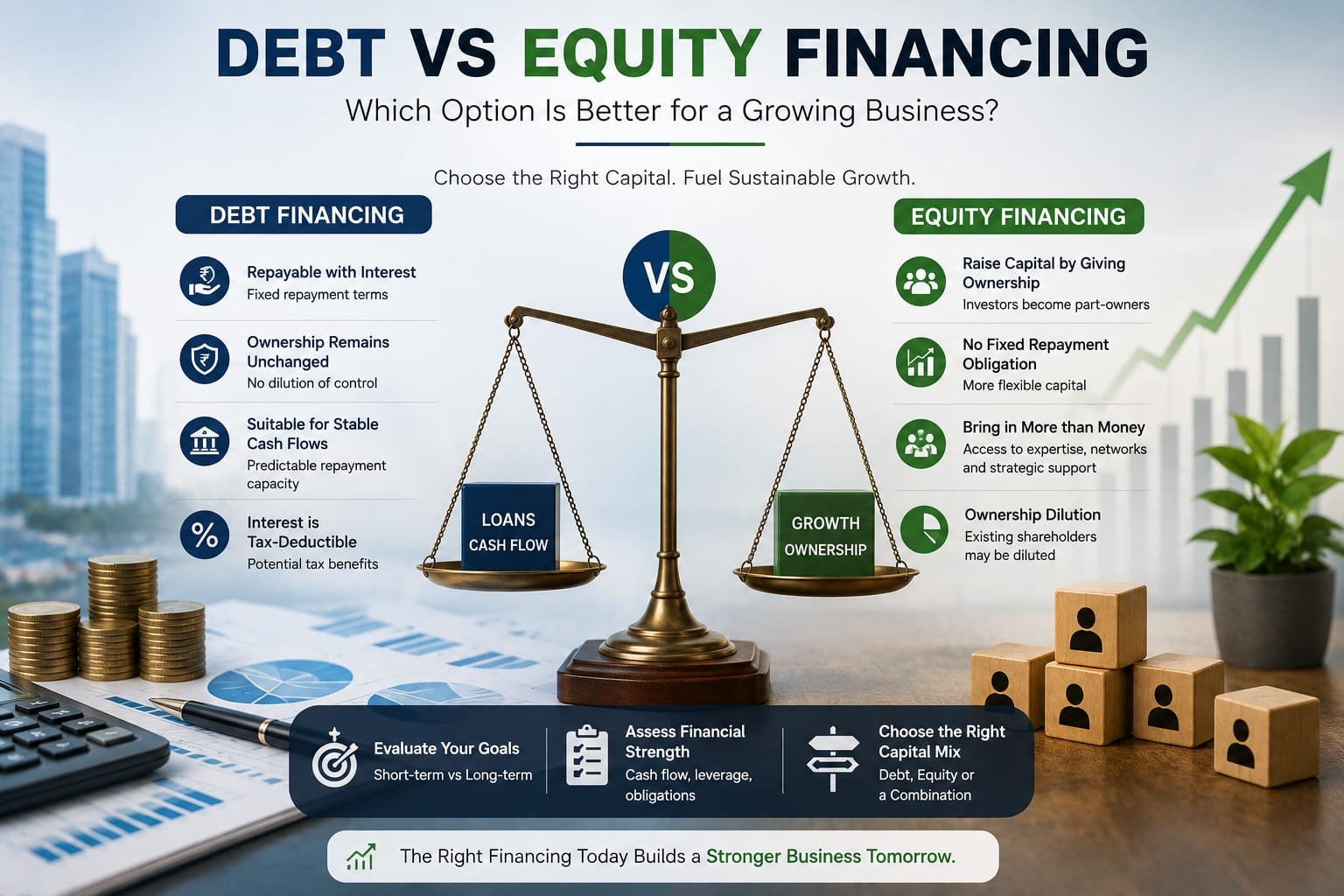
What Is Debt Financing? Debt financing means raising capital that the business is expected to repay, usually with interest, according to agreed terms. Common examples include business loans, term loans, working-capital facilities and other forms of borrowing. Debt allows existing owners to retain their ownership stake. However, it also creates a financial obligation that the company must manage regardless of whether business performance meets expectations. For a company with predictable cash flows and a clear repayment capacity, debt can be a practical source of growth capital. What Is Equity Financing? Equity financing involves raising capital by giving investors an ownership interest in the business. Unlike traditional debt, equity does not normally require repayment of the investment on a fixed schedule. However, existing shareholders may experience dilution of their ownership. Equity investors may also have expectations around business growth, governance, reporting and future liquidity. For businesses pursuing significant expansion or operating in situations where near-term cash flows may not support substantial debt repayments, equity can be worth considering. Debt vs Equity: What Should a Business Consider? The decision should not be based simply on which option is cheaper. Management should evaluate several factors. 1. Cash Flow A business with stable and predictable cash flows may be better positioned to service debt. If cash flows are uncertain, taking on significant repayment obligations may increase financial pressure. 2. Ownership and Dilution Debt generally does not require giving investors an ownership stake. Equity, on the other hand, can dilute existing ownership depending on the structure and valuation of the transaction. Founders should therefore understand the long-term ownership implications before choosing an equity route. 3. Growth Plans The purpose of the capital also matters. Funding a predictable expansion project may be approached differently from funding a high-growth business that expects substantial investment before reaching profitability. 4. Existing Financial Obligations Before taking on additional debt, a company should review its existing borrowing, repayment commitments and overall leverage. Adding more debt without considering the existing capital structure can create unnecessary financial pressure. 5. Cost of Capital Both debt and equity have an economic cost. Debt may involve interest and associated financing costs. Equity may involve dilution and sharing future economic value with investors. The comparison should therefore consider the overall cost and strategic impact, not just the immediate financing cost. Is a Combination of Debt and Equity Possible? Yes. Businesses do not always have to choose one option exclusively. A company may use a combination of debt and equity depending on its funding requirements, financial position and growth strategy. The objective is to develop a capital structure that supports growth without creating unnecessary financial or ownership pressure. Questions to Ask Before Choosing a Financing Route Before deciding how to raise capital, management should consider: ● How much capital is actually required? ● What will the funds be used for? ● How predictable are future cash flows? ● How much existing debt does the company have? ● Is ownership dilution acceptable? ● What is the expected return from the proposed investment? ● What financing structure is appropriate for the company's current stage? These questions can help move the discussion from "How can we raise money?" to "What type of capital is appropriate for our business?" Key Takeaway Debt and equity are not competing solutions in every situation. The appropriate financing route depends on the company's objectives, financial strength, ownership considerations and future plans. A structured capital-planning exercise can help management evaluate these factors before approaching lenders or investors. Kridha Advisors supports growth-focused businesses with capital planning, fundraising, financial modelling, due diligence and strategic transaction-related requirements, helping businesses approach important financial decisions with greater clarity and structure.