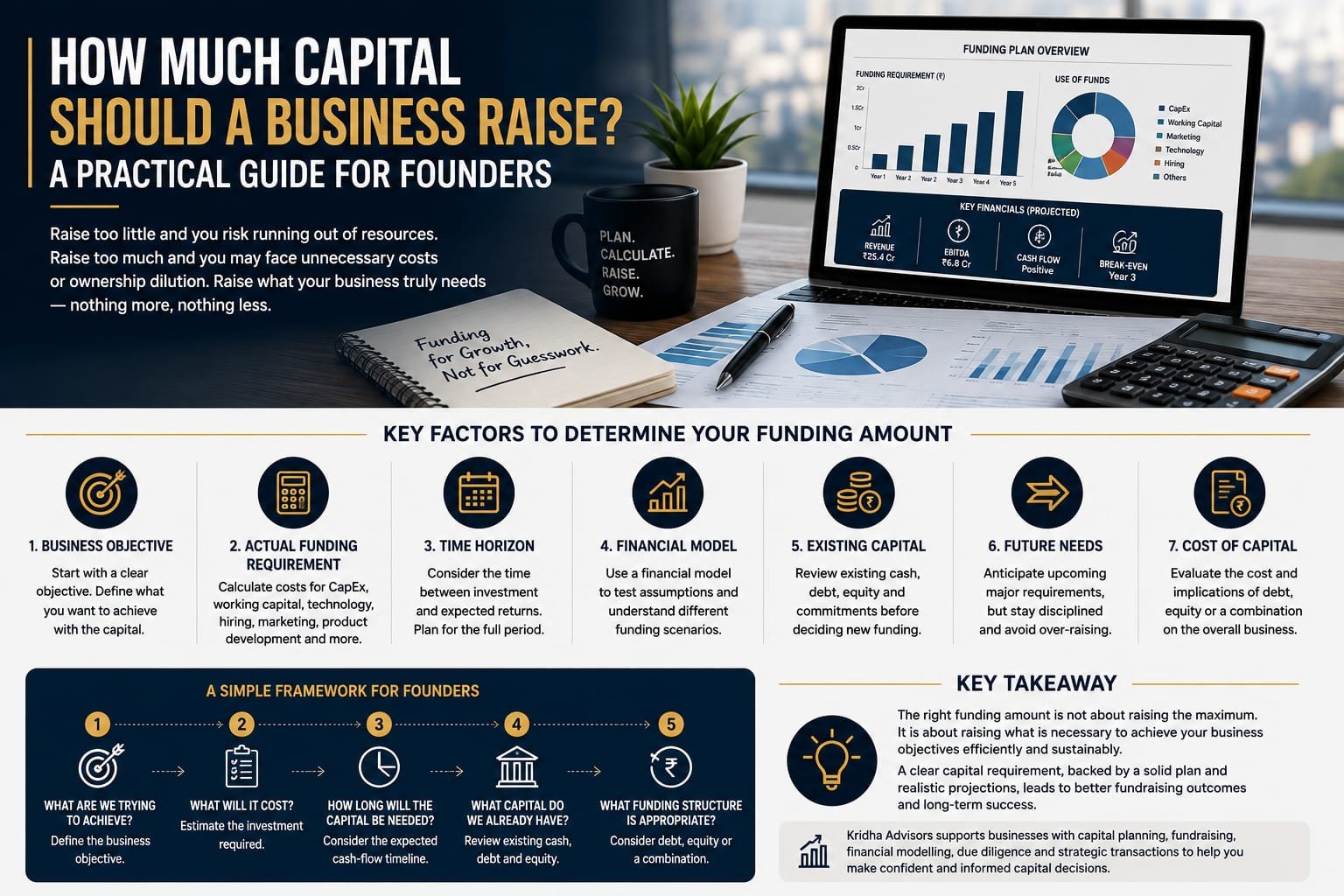
Start With the Business Objective
The first question should not be, "How much can we raise?"
It should be:
"What are we trying to achieve with the capital?"
A company may need funding to expand capacity, enter a new market, launch a product, strengthen working capital, invest in technology or pursue a strategic acquisition.
The funding requirement should be connected to a clearly defined business objective.
Calculate the Actual Funding Requirement
Once the objective is clear, management can estimate the financial resources required to achieve it.
This may include:
● Capital expenditure
● Working capital
● Technology and infrastructure
● Hiring and operating costs
● Marketing and market expansion
● Product development
● Acquisition-related expenses
These requirements should be supported by realistic assumptions and financial projections.
Consider the Time Horizon
The amount of capital required also depends on how long the funding needs to support the business.
For example, a company planning a major expansion may need to account for the period between making the initial investment and generating additional revenue from that expansion.
A funding plan should therefore consider expected cash requirements over a defined period rather than focusing only on immediate expenses.
Build a Financial Model
A financial model can help management understand how different funding scenarios may affect the business.
It can bring together:
● Revenue assumptions
● Operating expenses
● Cash flow
● Working capital
● Capital expenditure
● Existing debt
● Planned investments
This allows management to test different scenarios before deciding on a funding requirement.
Don't Ignore Existing Capital
New funding should be considered alongside the company's existing financial structure.
Management should review current debt, shareholder capital, previous investments and other financial commitments.
This provides a clearer picture of how new capital may affect the overall capital structure.
Think Beyond the Immediate Requirement
A business should also consider what happens after the capital is raised.
If the company expects another major funding requirement shortly after completing a round, it may be useful to understand that requirement in advance.
However, raising additional capital simply as a safety buffer may not always be appropriate. The amount should remain connected to a credible business plan and actual capital requirements.
Consider the Cost of Raising Capital
The amount raised can also influence the overall economics of the transaction. With debt, management needs to consider repayment obligations and financing costs. With equity, the implications may include ownership dilution and the expectations of new investors. Therefore, the objective should not be to maximise the amount raised. It should be to identify a capital requirement that is appropriate for the business and its next stage of growth.
A Simple Framework for Founders
Before finalising a fundraising target, management can work through five questions:
1. What are we trying to achieve?
Define the business objective.
2. What will it cost?
Estimate the investment required.
3. How long will the capital be needed?
Consider the expected cash-flow timeline.
4. What capital do we already have?
Review existing cash, debt and equity.
5. What funding structure is appropriate?
Consider the implications of debt, equity or a combination.
These questions can provide a more structured starting point for determining the funding requirement.
Key Takeaway
There is no universal funding amount that is right for every business.
The appropriate fundraising target depends on the company's objectives, financial position, projected requirements and growth plans. A well-defined capital requirement helps ensure that fundraising is connected to a specific business purpose rather than becoming an exercise in simply raising as much money as possible. Kridha Advisors supports growth-focused businesses across capital planning, fundraising, financial modelling, due diligence and strategic transactions, helping businesses approach capital decisions with greater structure and clarity.