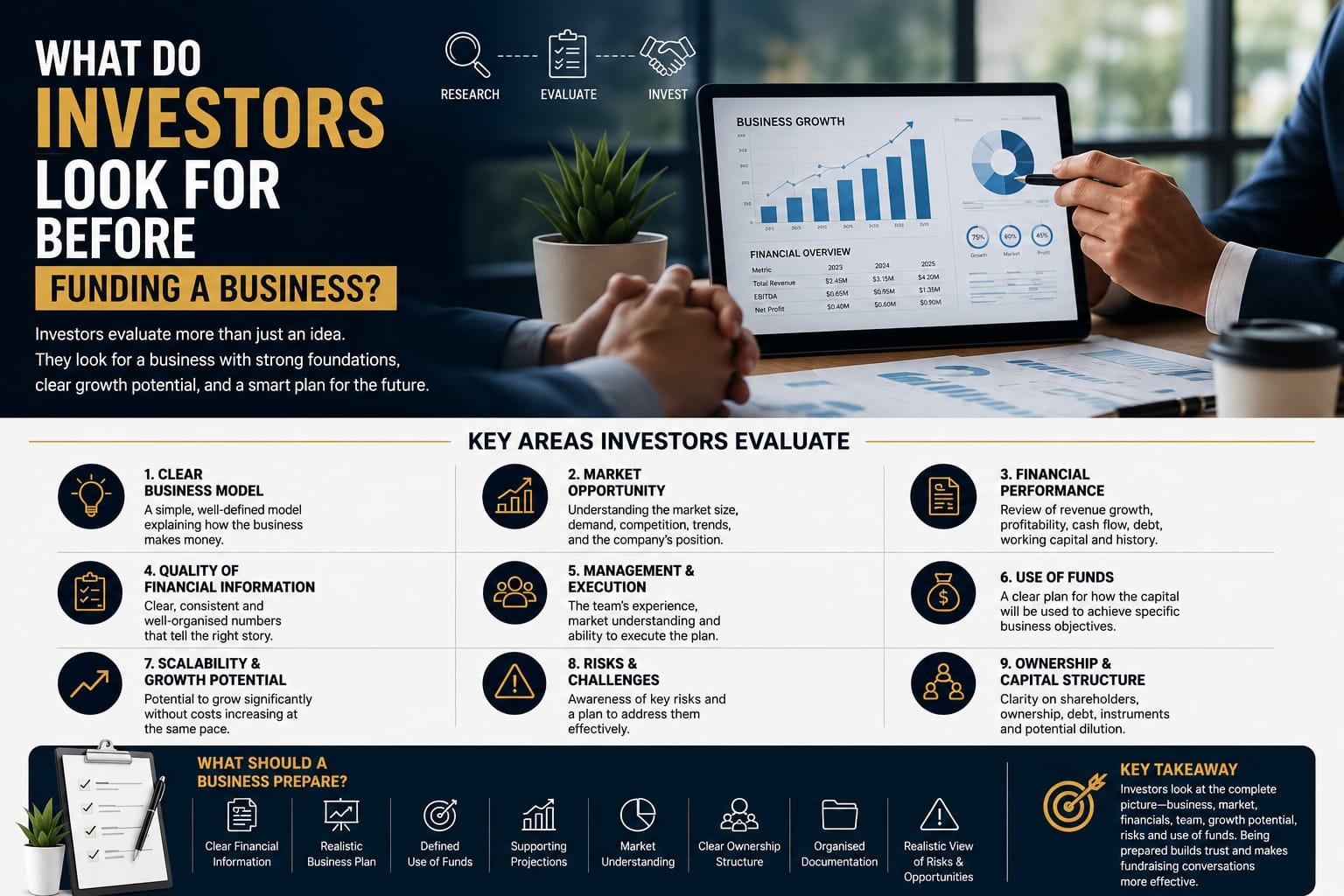
1. A Clear Business Model
Investors need to understand how the company makes money.
A business should be able to clearly explain its products or services, target market, revenue model and key drivers of growth.
A complicated explanation can make it harder for an investor to understand the underlying opportunity.
2. Evidence of Market Opportunity
Investors generally look beyond the current size of a business.
They want to understand the market in which the company operates and whether there is sufficient opportunity for future growth.
Relevant factors may include:
● Market size
● Customer demand
● Competitive landscape
● Industry trends
● Expansion opportunities
● Company's position within the market
A growing market does not automatically make a business investable, but it can provide important context for evaluating its growth potential.
3. Financial Performance
Financial information is an important part of an investment discussion.
Depending on the business and transaction, investors may review:
● Revenue growth
● Profitability
● Cash flow
● Working capital
● Existing debt
● Historical financial performance
The objective is not simply to look at one year's revenue or profit. Investors need to understand the broader financial trend and the factors driving it.
4. Quality of Financial Information
Having financial numbers is different from having financial information that can be clearly explained. Investors may ask how revenue is generated, why margins changed, what drives expenses and how future projections were developed.
Consistent and well-organised financial information can make these discussions more efficient.
This is where appropriate financial modelling and preparation can become important.
5. Management and Execution Capability
Capital is ultimately being invested into a business and the people running it.
Investors may therefore consider the management team's understanding of the market, operational capabilities, decision-making and ability to execute the proposed growth strategy.
A strong plan needs a capable team behind it.
6. Use of Funds
One of the most important questions in a fundraising discussion is:
What will the company do with the capital? A funding requirement should ideally be linked to specific business objectives.
For example, funds may be intended for:
● Capacity expansion
● Technology
● New market entry
● Working capital
● Product development
● Strategic acquisitions
The more clearly the proposed use of funds connects with the company's growth plan, the easier it becomes to understand the purpose of the capital.
7. Scalability and Growth Potential
Investors may also consider whether the business can grow significantly without costs increasing at the same pace.
The answer depends heavily on the industry and business model.
A company should be able to explain what will drive its next stage of growth and what resources will be required to achieve it.
8. Risks and Challenges
A credible fundraising discussion should not ignore risks.
Businesses operate in competitive and changing markets.Investors may examine regulatory, operational, financial, market and execution-related risks.
Acknowledging these risks and explaining how management plans to address them can create a more realistic investment discussion.
9. Ownership and Capital Structure
Investors also need clarity around the company's existing ownership and capital structure.
This can include:
● Existing shareholders
● Promoter ownership
● Previous investors
● Outstanding debt
● Convertible instruments
● Potential dilution
A clear understanding of the current structure helps stakeholders evaluate the proposed transaction more effectively.
What Should a Business Prepare Before Approaching Investors?
A company considering fundraising should ideally have:
● Clear financial information
● A realistic business plan
● Defined use of funds
● Supporting financial projections
● An understanding of its market
● A clear ownership structure
● Organised documentation
● A realistic view of risks and opportunities
Key Takeaway
Investors do not evaluate a business based on a single number or presentation.
They look at the business, market, financial position, management, growth opportunity, risks and proposed use of capital as a connected picture.
For founders, the objective should therefore be more than simply preparing a pitch. It should be preparing the business to withstand the questions that come with a serious funding discussion.
Kridha Advisors supports growth-focused businesses across capital planning, fundraising, financial modelling, due diligence and strategic transactions, helping businesses approach important capital decisions with greater structure and clarity.